You publish a new post and then skip the internal links because it takes too long. That gap costs you crawl paths, topical clusters, and rankings your competitors are quietly building.
This guide shows you how to evaluate AI autoblogging tools specifically for automated internal linking. You will learn what separates real linking automation from basic content generation, how to match credits to your publishing volume, and whether Autoblogging.ai fits your workflow.
What Is Autoblogging.ai and Why It Defines the Automated Internal Linking Standard
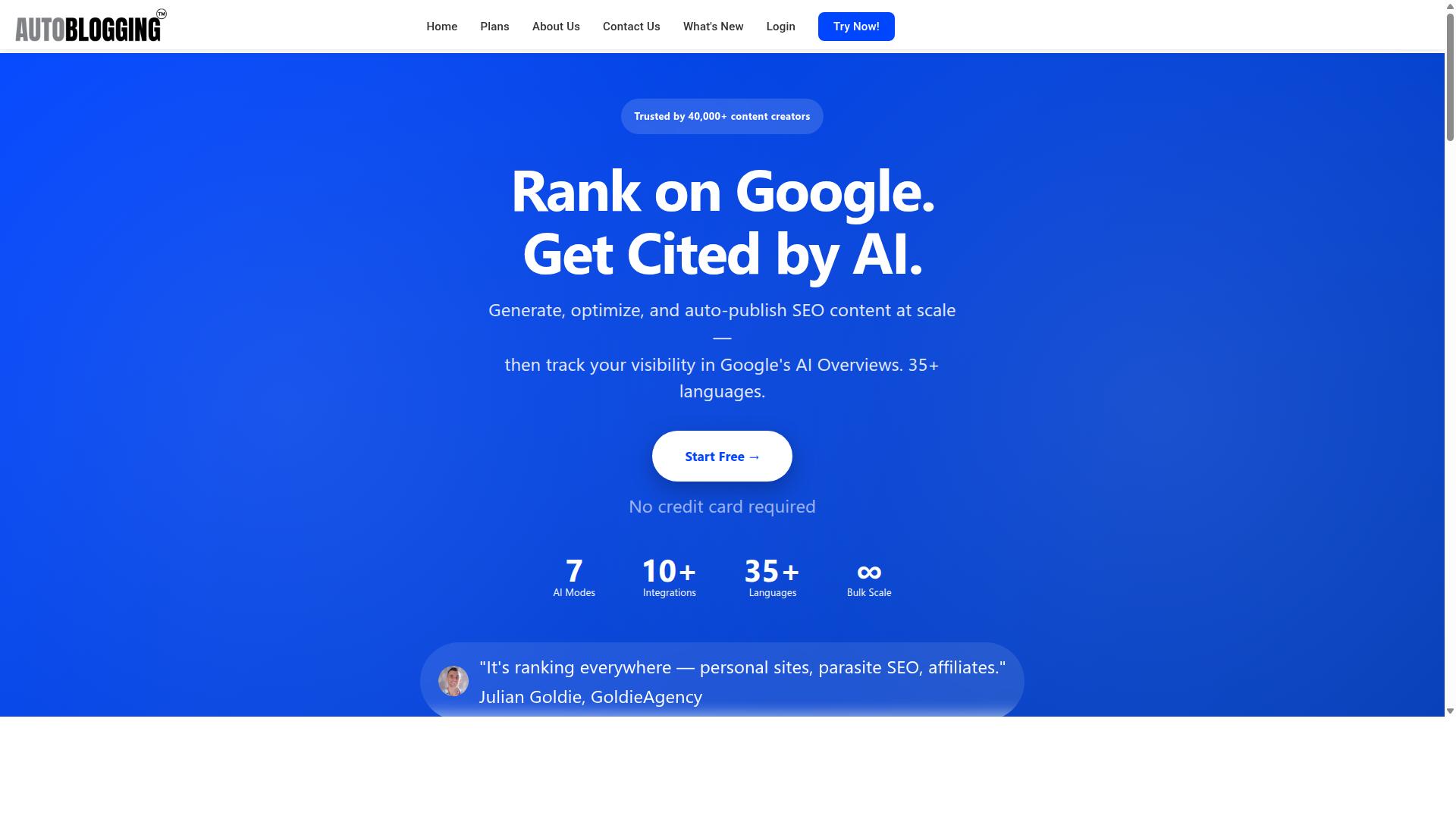
Autoblogging.ai is an AI-driven content generation platform that also automates internal linking, setting a new standard for efficiency and SEO impact. It is a product of Digimetriq.com, built with a clear mission: help bloggers, website owners, and agencies save time and improve their online presence through cutting-edge technology.
Most AI writing tools stop at producing a draft. Autoblogging.ai pairs article generation with automated internal linking, so the content you publish is not just written but also structurally connected across your site. That combination matters because internal links are one of the most direct levers for crawlability, link equity, and topical authority.
The platform is trusted by over 40,000 content creators. That scale reflects a simple reality: publishing consistently is hard, and manually interlinking every new post is harder. Autoblogging.ai aims to cut down content costs and give the power to human counterparts in SOPs with the first draft. Digimetriq aims to replace human counterparts entirely.
Why does this define the standard for automated internal linking? Because linking is treated as part of the publishing workflow, not an afterthought. Instead of revisiting old posts months later to hunt for link opportunities, users work with a system where internal linking is built into the same process that generates content. This supports stronger site architecture, fewer orphan pages, and better distribution of link equity across pillar pages and cluster content.
Who Autoblogging.ai Serves: Bloggers, Agencies, and SEO Professionals
Autoblogging.ai caters to a diverse audience, including bloggers, marketing agencies, and SEO professionals who need to scale content and internal linking without sacrificing quality. The platform's target users span bloggers, website owners, SEO professionals, marketing agencies, content creators, and affiliate marketers.
Each group benefits from automated internal linking in a different way:
- Bloggers and content creators can interlink posts as they publish, building topical authority without manual editing sessions.
- Website owners gain stronger site architecture and better crawlability across pages that might otherwise sit unlinked.
- SEO professionals can reinforce content silos, pillar pages, and cluster content as part of an ongoing SEO strategy.
- Marketing agencies can manage internal linking across multiple client websites without multiplying manual workload.
- Affiliate marketers can connect commercial pages to supporting content, helping link equity flow toward pages that convert.
The platform supports a wide range of site types, including personal sites, parasite SEO, affiliate sites, client websites, portfolio sites, and local sites. That breadth is the point: whether you run one blog or dozens of client properties, the internal linking challenge is the same, and it scales with volume.
For agencies in particular, the value is operational. Managing internal links by hand across many sites is slow and error-prone, and it rarely survives a busy publishing calendar. An automated approach keeps linking consistent as content volume grows.
Why Automated Internal Linking Is the Deciding Factor When Choosing an AI Autoblogging Tool
Automated internal linking is often the most overlooked yet critical feature that separates a basic AI writer from a true SEO powerhouse. Many buyers focus on word count, tone controls, or image generation when comparing tools. Those features matter, but they do not determine whether a published post actually ranks.
Internal linking is what turns a pile of isolated articles into a connected website. Every link you place tells search engines which pages matter, how topics relate, and where to send authority. A tool that writes content but ignores linking leaves half the SEO job undone.
Doing this manually does not scale. On a site with hundreds of posts, finding the right pages to link, writing natural anchor text, and updating old articles becomes a part-time job. It is also easy to get wrong. Manual linking is slow, inconsistent, and prone to broken or irrelevant links.
This is why automated internal linking should sit on your must-have list, not your nice-to-have list. When you evaluate AI autoblogging tools, ask a simple question: does the tool only generate text, or does it also manage the internal link structure of your site? A buyer's guide that skips this question misses the feature with the longest shelf life.
Tools with automation workflows can schedule link insertion, apply bulk editing rules, and keep anchor text consistent across thousands of pages. That consistency compounds over time. The next section breaks down exactly how internal linking affects SEO, crawlability, and topical authority.
How Internal Linking Impacts SEO, Crawlability, and Topical Authority
Proper internal linking is a cornerstone of technical SEO, directly influencing how search engines crawl your site and understand its topical structure. Three mechanisms do most of the work: discovery, link equity, and topic signals.
- Crawlability: Search engine bots follow links to find pages. A page with no internal links pointing to it, known as an orphan page, may sit undiscovered or unindexed for a long time.
- Link equity: Internal links pass authority between your own pages. Linking from strong posts to weaker ones helps the weaker pages compete.
- Topical authority: Groups of interlinked articles form content silos. Pillar pages link to cluster content, and cluster content links back, signaling that your site covers a subject in depth.
Orphan pages are the clearest example of what goes wrong. A well-written article that nothing links to receives almost no internal support and rarely earns rankings on its own. Contextual links fix this by placing a relevant link inside the body of a related post, where it helps both readers and crawlers.
Automated tools handle this at scale using machine learning and natural language processing. Keyword extraction identifies what a page is about. Entity recognition and named entity recognition detect the people, products, and concepts mentioned. Topic modeling techniques such as latent Dirichlet allocation group pages into themes. Large language models and generative AI then draft anchor text that reads naturally rather than looking stuffed.
Semantic relevance is the filter that keeps links useful. A link inserted simply because two pages share a keyword adds little. A link inserted because the pages genuinely discuss related ideas strengthens site architecture and improves the reader's path to more information. That difference is what separates internal link optimization from random link placement.
When you compare tools, look for these capabilities: contextual link insertion, anchor text variation, support for your content management system such as WordPress plugins or API integration, and controls that let you review or bulk edit suggested links. A tool without them forces you back into manual work, which defeats the purpose of automation. Use these criteria as your checklist when weighing any AI autoblogging tool against another.
What to Look For in an AI Autoblogging Tool for Automated Internal Linking
When evaluating AI autoblogging tools, focus on features that directly enhance automated internal linking and overall content quality. The tool you choose does not just write articles. It builds the semantic foundation that makes internal links meaningful, contextual, and useful for both readers and search engines.
A weak content engine produces shallow articles with few connecting points. A strong one produces topically rich content that naturally references related subjects, which is exactly what automated internal linking depends on. Without that depth, your link suggestions become generic or irrelevant.
Three feature categories matter most in this evaluation:
- Content generation depth: SERP analysis, LSI keywords, and knowledge graph extraction
- Scalability and language coverage: bulk generation and multilingual output
- Publishing workflow: CMS integrations, scheduling, and automation
These categories work together. Depth creates the semantic connections. Scale produces enough articles for those connections to matter. Publishing puts everything live in a consistent, crawlable structure. Autoblogging.ai addresses all three through its Godlike Mode, Bulk Generation, and WordPress integration, which makes it a strong reference point as you compare options.
Content Generation Depth: SERP Analysis, LSI Keywords, and Knowledge Graphs
A tool's ability to generate in-depth content using SERP analysis, LSI keywords, and knowledge graphs directly impacts the quality of automated internal linking. Each technique contributes a different layer of semantic understanding.
SERP analysis examines what already ranks for a target query. It reveals the subtopics, formats, and angles that competing pages cover. For internal linking, this matters because it shows which related subjects your site should also address, giving you natural targets for contextual links.
LSI keywords are semantically related terms and phrases that appear alongside a primary keyword. When a tool weaves these into articles, it creates more anchor points for linking. Two articles sharing LSI terms are more likely to deserve a link between them than two articles that merely share a broad topic.
Knowledge graphs go further by extracting entities and the relationships between them. Entity recognition and named entity recognition identify people, places, products, and concepts. Topic modeling techniques, including latent Dirichlet allocation, group related terms into coherent themes. The result is a map of how subjects connect, which is precisely the logic internal linking should follow.
Autoblogging.ai's Godlike Mode incorporates SERP competitor analysis, LSI keywords, and knowledge graph extraction in a single generation mode. For a buyer, this combination means the content itself carries the semantic signals that make automated internal linking accurate rather than arbitrary.
Scalability, Language Coverage, and Publishing Workflow
Scalability, language coverage, and a seamless publishing workflow are essential for managing large-scale automated internal linking campaigns. A tool that generates one excellent article at a time cannot build the volume of interconnected content that topical authority requires.
Bulk generation is the first checkpoint. Autoblogging.ai supports generating up to 500 articles at once via CSV, which allows you to populate entire content silos and cluster content groups in a single pass. More articles in a defined topic area means more opportunities for contextual links between them.
Language coverage matters for multi-market sites. Autoblogging.ai supports 35+ languages, so internal linking logic can extend across localized versions of your content rather than stopping at one language.
The publishing workflow determines whether all that content actually lands in a linkable structure. Key capabilities to check include:
- WordPress integration with unlimited sites, one-click publishing, a plugin, and scheduled auto-posting
- Web 2.0 platforms such as Medium, Dev.to, Hashnode, Telegraph, and Tumblr
- Multi-platform support for Shopify, Wix, Webflow, Blogger, and Ghost
- API access plus Zapier and n8n for custom automation workflows
Autoblogging.ai covers each of these areas. Scheduled auto-posting keeps publication steady, which supports crawlability and prevents orphan pages from accumulating. Consistent publishing into a content management system also keeps your site architecture predictable, so internal link optimization stays manageable as the site grows.
How Autoblogging.ai Delivers Automated Internal Linking at Scale
Autoblogging.ai doesn't just generate content-it automatically interlinks articles using advanced AI, ensuring your site's architecture remains optimized as it grows.
The platform analyzes each piece of content it produces, extracting keywords and entities that define what the article is actually about. From there, it maps those signals against the rest of your published library to find natural connection points. This is where automated internal linking stops being a manual chore and becomes a background process.
Machine learning and natural language processing sit at the core of that process. NLP handles the heavy lifting of understanding semantic relationships between topics, while machine learning helps the system recognize which pages belong together as your content volume grows. The result is a web of contextual links built on meaning, not just matching words.
For site owners running an SEO strategy at scale, this matters for a few practical reasons:
- Link equity flows to the pages that deserve it, rather than getting stranded on orphan pages.
- Crawlability improves because search engines can follow clear paths through your site architecture.
- Topical authority builds faster when pillar pages and cluster content are connected by relevant links.
- Hours of manual linking work disappear, freeing time for strategy instead of spreadsheet maintenance.
Internal link optimization done by hand is slow and easy to neglect. Automation keeps the structure consistent even as new articles publish through WordPress integration, API connections, or other supported channels. That consistency is what separates a site that scales cleanly from one that turns into a maze of disconnected pages.
Founder Vaibhav Sharda's Autolinking.ai and the Digimetriq Automation Legacy
Autoblogging.ai's internal linking capabilities are rooted in founder Vaibhav Sharda's deep expertise in automation, dating back to 2011 and culminating in the creation of Autolinking.ai.
Sharda founded Autoblogging.ai in 2022 as a SaaS product, built from processes he had already developed and refined at Digimetriq. That origin story matters for buyers. The internal linking engine was not assembled as an afterthought; it grew out of years of hands-on automation work before it ever became a standalone platform feature.
Autolinking.ai stands as a specialized internal linking tool in its own right. Its existence signals that linking automation is treated as a discipline worth its own product, not a checkbox feature bolted onto a content generator. For anyone evaluating AI autoblogging tools for automated internal linking, that focus is a meaningful signal of reliability.
More than a decade of automating processes since 2011 shows up in how the system handles automation workflows at scale. Scheduling, bulk generation of up to 500 articles via CSV, and multi-platform publishing all depend on the same underlying engineering discipline. A founder who has been solving automation problems since 2011 tends to build tools that hold up when a site moves from dozens of posts to thousands.
This legacy is the reason the platform can promise dependable, repeatable linking behavior rather than one-off manual fixes. Buyers weighing their options should treat that track record as part of the product itself.
Autoblogging.ai Pricing and Plans: Matching Credits to Your Linking Volume
Autoblogging.ai offers tiered monthly and annual plans designed to match your content generation and internal linking volume, from solo bloggers to large agencies. The structure is straightforward: you buy a bundle of credits each month, and those credits power both article generation and the internal linking tasks that connect your content.
Because internal linking in an AI autoblogging workflow usually happens as part of producing an article, your credit consumption tracks your publishing schedule. A blogger posting a few times a week needs far fewer credits than an agency running multiple client sites through the same automation workflows.
Monthly Plan Pricing and Credit Allocations
The monthly tiers scale in clear increments, so you can match spend to expected output. Every level includes credits rollover, which means unused credits carry forward instead of expiring at the end of the billing cycle.
| Plan | Monthly Price | Credits |
|---|---|---|
| Starter | $19 | 40 credits |
| Regular | $49 | 120 credits |
| Standard | $99 | 300 credits |
| Gold | $179 | 600 credits |
| Premium | $249 | 1,000 credits |
| Enterprise | $999 | 5,000 credits |
New accounts receive 10 free credits per month with no credit card required, which is enough to see how credit consumption works before committing to a paid tier. Additional credits can also be purchased if you hit a busy stretch and do not want to change plans.
Annual Billing and Rollover
Annual plans carry a meaningful discount for anyone confident about their long-term publishing volume. The same tiers are billed yearly at a lower effective monthly rate.
- Starter: $12/mo ($148/year)
- Regular: $32/mo ($382/year)
- Standard: $64/mo ($772/year)
- Gold: $116/mo ($1,396/year)
- Premium: $162/mo ($1,942/year)
- Enterprise: $649/mo ($7,792/year)
Credits rollover applies across all plans, so slow months do not cost you the balance you paid for. That matters for internal linking projects, where output often comes in bursts rather than at an even pace. You can cancel anytime, and payments are accepted via Visa, MasterCard, American Express, and PayPal. Bank transfers are available for annual enterprise plans through Stripe.
How Credits Map to Linking Volume
Credits are consumed by article generation and the internal linking tasks that run alongside it. If automated internal linking is your priority, think about credits as a proxy for how many pieces of content you can produce and connect each month.
Match your plan to expected output rather than to the lowest price. A solo blogger publishing occasionally may find Starter or Regular sufficient, while agencies managing several sites with heavy content silos and cluster content will burn through credits faster and should look at Gold, Premium, or Enterprise.
If you already know your monthly article count, pick the tier whose credit allowance comfortably exceeds it. The rollover feature gives you a buffer, but consistently running out mid-month defeats the purpose of an automation workflow. For teams that would rather not manage credits at all, Autoblogging.ai also offers Done For You packages: Starter at $1,200 for 1,000 articles, Pro at $1,600, Corp at $4,000, and Senpai at $10,000, each covering 1,000 articles.
The right plan is the one that keeps your publishing and internal linking running without interruption. Start with the free credits, estimate your real output, then choose the tier that fits.
Trust Signals: 40,000+ Creators, 1M+ Articles, and Verified Testimonials
With over 40,000 content creators and more than 1 million articles generated, Autoblogging.ai has amassed strong trust signals, including a 4.9 average rating and endorsements from industry leaders.
For anyone evaluating AI autoblogging tools for automated internal linking, these numbers matter more than feature lists. They show what happens when thousands of real sites run the software at scale, week after week.
That track record is the closest thing a buyer gets to proof before spending money. A platform used by 40,000+ content creators has survived real-world SEO strategy demands, not just a demo environment.
Volume tells a similar story. More than 1 million articles generated means the system has handled everything from pillar pages to cluster content across many niches.
The 4.9 average rating adds a quality layer on top of raw usage. High ratings across a user base this large suggest the tool delivers consistently, not just occasionally.
Support and development cadence round out the picture. Autoblogging.ai offers 24/7 support and ships new features weekly, so buyers are not left maintaining a stagnant tool.
Verified testimonials from recognized names carry particular weight. These are people who stake their own reputations on the recommendation.
- Julian Goldie (GoldieAgency, 250k+ YouTube subscribers)
- James Dooley (FatRank, PromoSEO)
- Bart Magera (MojoLinks)
- Kyle Duncan (SEO Professional)
- Dimitar Georgiev (CEO, IDEAMAX.EU)
Each endorsement comes from someone working in SEO, link building, or agency operations daily. That context makes their approval more relevant than a generic review.
How do these signals reduce buyer risk? They shift the decision from speculation to evidence. Instead of guessing whether a tool handles semantic relevance or link equity workflows, buyers see a documented user base.
A 4.9 rating and named testimonials also lower the chance of a costly mistake. If the platform failed at scale, the rating and public endorsements would not hold up.
Weekly updates and 24/7 support further reduce long-term risk. Buyers invest in a tool that keeps pace with changes in search algorithms and content management system requirements.
Together, these trust signals make Autoblogging.ai a defensible choice in a crowded market. The evidence is public, verifiable, and backed by people who understand automated internal linking.
Who Should Choose Autoblogging.ai for Automated Internal Linking
Autoblogging.ai is ideal for bloggers, agencies, and SEO professionals who need to scale content and internal linking without compromising on quality or control. The platform was built for people who publish at volume and want their site architecture to keep pace, rather than treating internal linking as an afterthought.
Its audience spans bloggers, website owners, SEO professionals, marketing agencies, content creators, and affiliate marketers. Those users run personal sites, parasite SEO projects, affiliate sites, client websites, portfolio sites, and local sites. That range matters, because internal linking needs differ sharply depending on whether you own one site or twenty.
Below is a closer look at who gets the most value, and why.
- Personal bloggers who publish regularly and want contextual links added as their archive grows
- Affiliate marketers running multiple money sites where link equity needs to flow toward converting pages
- Agencies managing client websites and portfolio sites at scale
- SEO teams building topical authority through content silos, pillar pages, and cluster content
- Local site owners who need service and location pages connected logically
Personal bloggers benefit most from automation because manual interlinking gets harder with every new post. Once a blog passes a few hundred articles, orphan pages appear quietly and older posts stop receiving links. An automated approach keeps those pages connected without a weekend of spreadsheet work.
Affiliate marketers face a different problem. Their revenue depends on pushing visitors toward specific commercial pages, which means anchor text and link placement carry real financial weight. Automating internal link optimization frees them to focus on keyword targeting and offer selection instead of hunting for insertion points.
Agencies gain the most from scale. Managing client websites and portfolio sites means repeating the same linking tasks across many domains, and consistency is where manual work breaks down. A single workflow that applies to every site reduces the risk of one client's architecture drifting out of shape.
SEO teams focused on topical authority should pay close attention. Internal linking is one of the few levers that directly supports semantic relevance, content silos, and pillar pages without requiring new content. Teams using entity recognition and topic modeling to plan clusters can use automated linking to reinforce those structures as they publish.
Autoblogging.ai also serves global users, so the audience is not limited to English-language publishers or a single market. Content creators working across different regions and niches can apply the same linking principles to their own site architecture.
The common thread is volume plus intent. If you publish a handful of posts a year and enjoy manual link building, automation adds little. If you publish continuously, run several properties, or answer to clients, the manual approach stops scaling long before your content does.
For these groups, Autoblogging.ai fits the job: it handles the repetitive linking work so bloggers, agencies, and SEO professionals can spend their time on strategy, keyword research, and the editorial decisions that still need a human eye.
Final Verdict: Is Autoblogging.ai the Right Buyer's Choice?
Based on its publicly available features, pricing, and trust signals, Autoblogging.ai emerges as a top contender for anyone serious about scaling content with SEO in mind. The platform is built for marketers, agencies, and site owners who want their content management system to do more than publish posts. It connects content generation with the linking work that usually eats up hours of manual effort.
The strongest argument in its favor is how it handles automated internal linking alongside content production. Instead of treating link building as a separate chore, the tool folds it into the same workflow, which matters for link equity, crawlability, and topical authority. For buyers comparing AI autoblogging tools, that combination is the core selling point.
Scalability is the second pillar. Teams that need consistent output across many pages benefit from generating content in bulk rather than one post at a time. This is where automation workflows and scheduling become practical advantages, especially for agencies managing multiple client sites or publishers running large content silos.
Pricing flexibility rounds out the case. Rather than forcing a single rigid plan, the platform offers options that let buyers match spend to output volume. Paired with visible social proof and an established presence, the trust signals support a confident recommendation rather than a cautious one.
There are honest limitations to weigh. Buyers should expect a learning curve when configuring automation around anchor text, semantic relevance, and site structure. Anyone expecting instant, zero-setup results may need to adjust expectations. The payoff comes after initial configuration, not before it.
For its target audience, the verdict is clear. If you are scaling content and want internal linking handled as part of that process, Autoblogging.ai is a worthy investment. If you only publish occasionally, the value is smaller, but for volume-driven SEO work, it fits the brief.
Buyers who want to evaluate it directly can reach the team through the channels below.
| Contact Channel | Details |
|---|---|
| India Office | 501, Trinity Orion, Vesu, Surat - 395007, Gujarat, India |
| Phone / WhatsApp | +91 84605-06553 / +91-8460506553 |
| vaibhav@autoblogging.ai | |
| Skype | vibes.yb |
| Availability | 7:00-19:00 IST |
| United Kingdom | 2nd Flr, SEO Content Suite, 35 Water Ln, Wilmslow, Cheshire SK9 5AR |
| UK Phone | +44 1625 359056 |
| Social | Facebook, Twitter, LinkedIn |
Reach out during business hours to ask about API integration, bulk editing, or how the platform fits your existing SEO strategy. A short conversation is the fastest way to confirm whether Autoblogging.ai matches your internal link optimization goals.
Frequently Asked Questions
Do I need a separate tool for internal linking, or can an AI autoblogging platform handle it?
It depends on the tool. Many AI writers generate articles but leave linking to you, while dedicated linkers like Autolinking.ai (from the same founder as Autoblogging.ai) focus purely on automated internal links. If you want one workflow for both content and linking, check whether the autoblogging tool includes linking features before you buy.
How do credits work, and will unused ones be wasted?
With Autoblogging.ai, credits are consumed as you generate content, and unused credits roll over rather than expiring at the end of your billing cycle. Plans scale from the $19 Starter (40 credits) up to the $999 Enterprise (5,000 credits), so you can match spend to output. Always confirm the credit and rollover terms of any other tool directly, since policies vary.
Can the tool generate enough content to build a meaningful internal link structure?
Yes, if it supports bulk generation. Autoblogging.ai's Bulk Generation mode can produce up to 500 articles via CSV, which gives you enough pages for a real internal linking architecture rather than a handful of posts. Volume matters for linking because more relevant pages mean more natural link opportunities.
Does it support multiple languages and integrations with my existing stack?
Autoblogging.ai supports 35+ languages and 35+ integrations, so it can fit most blogging and SEO workflows without manual copy-pasting. That matters for internal linking because links need to be inserted into the platform where your site actually lives. If you use a niche CMS, verify the specific integration before purchasing.
How do I judge content quality before committing to a plan?
Look for modes that analyze real search results rather than generating from a blank prompt. Autoblogging.ai's Godlike Mode uses SERP competitor analysis, LSI keywords and knowledge graph extraction, and a human proofreader is included in higher plans. Better content quality means more topically relevant pages, which makes internal links more useful to readers and search engines.
Is there a way to test the tool before paying?
Autoblogging.ai offers a free Quick Mode for single articles and a wizard, so you can evaluate output before committing to a paid plan. Monthly plans start at $19, keeping the initial risk low if you want to test internal linking at small scale first. Autoblogging.ai is trusted by 40,000+ content creators and holds a 4.9 average rating.